Personality·Soul Exchange
The Thing on the DoorstepPersonality/Soul Exchange is the story’s supernatural mechanism for separating a person’s consciousness from its familiar body and placing it in another. It begins as an unsettling effect associated with Asenath Waite’s hypnotism, but Edward Pickman Derby’s disclosures turn it into a sustained struggle over identity, bodily control, and survival. The story’s evidence accumulates through secondhand reports, Edward’s increasingly coherent explanations, and physical traces that complicate Daniel Upton’s initial belief that his friend is delusional.
Early Signs and the Mind-Body Problem
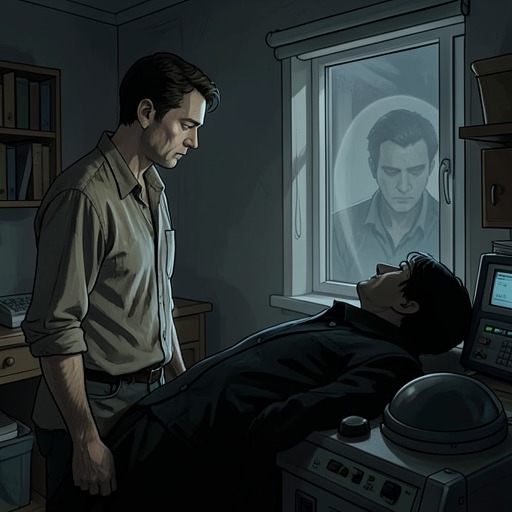
As a student, Asenath Waite could induce another person to feel, briefly, as though their personality had shifted into her body. The subject seemed able to look across the room from her position while Asenath’s own face displayed an alien expression. These episodes are presented as more than ordinary persuasion: they suggest a temporary displacement of perspective, though they do not yet establish that a soul has permanently changed bodies.
Asenath’s ideas give the episodes a larger implication. She claimed that consciousness could exist independently of the physical frame, or at least independently of its ordinary life processes. She also believed that a male brain possessed distinctive cosmic powers and that, given one, she could exceed Ephraim Waite’s command of unknown forces. The story thus connects the exchange not only to hypnotic influence but to the possibility that a person might treat the body as a transferable vessel—and that the desire for a different body could become an overriding objective.
Edward Derby’s Repeated Exchanges
After marrying Asenath, Edward describes a pattern in which she takes control of his body and leaves him in hers, sometimes confining him upstairs while she travels elsewhere. He says she uses these exchanges to reach remote places and participate in secret rites. The change is not always stable: at times Edward suddenly finds himself restored to his own body in an unfamiliar location, while Asenath’s control over him appears to come and go. He has repeatedly had to make his way back from distant places, and he believes that she can hold him for longer as time passes.
Edward’s account develops from frightening episodes into a prediction of permanent dispossession. He believes Asenath has selected him because he combines an unusually capable mind with a weak will. In his view, she intends to crowd him out, keep his body, and leave him stranded in hers. He connects that intended outcome to her wish to become a man and to the power she associates with a male brain. His fear is therefore not simply that Asenath can control his actions: it is that she can make the separation of identity and body irreversible.
During the journey back from Maine, Edward also recounts being taken to a hidden ritual site against his will. He says that one moment he was confined in a library and the next he was in a place where Asenath had gone with his body. His disordered account includes a great staircase, a sacrificial setting, a hooded figure, and a Shoggoth that changes form. Daniel Upton initially interprets the story as hallucination rooted in an actual ordeal. The episode nevertheless extends the concept beyond intimate bodily control: an exchange can make its victim a witness to places and events otherwise inaccessible to him.
Ephraim Waite and the Suspected Precedent
Edward’s explanation of Asenath’s identity begins as a suspicion and becomes a claim he says he can support. He notices that her handwriting, when she is off guard, resembles Ephraim Waite’s manuscripts, and that she sometimes speaks with the knowledge and manner of an old man. He concludes that Ephraim exchanged forms with his daughter as he approached death, placing himself permanently in her body and leaving her in his former one. Edward further suspects that Ephraim then arranged the death of the body he had abandoned.
The proposed history turns the exchanges between Edward and Asenath into a repetition of an earlier act. Edward asks whether Asenath was ever truly herself, and whether the person confined during Ephraim’s final illness was his daughter rather than the old man. He also links Ephraim’s search for a person with a fine mind and weak will to the qualities he believes Asenath later sought in him. The story does not provide an independent account of the earlier exchange, so the particulars remain Edward’s reconstruction; however, the resemblance between his feared fate and the history he attributes to Ephraim gives the theory a clear narrative function.
Edward’s account also joins exchange to the idea of a life-glow that can persist after bodily death. He believes Ephraim learned from the Necronomicon how to break the link between consciousness and the body, allowing the life-glow to continue for a time after the body dies. This claim supplies the rule Edward thinks governs the final stage of the process: killing a body does not necessarily end the agency that has occupied it.
Death, Continuation, and Material Traces
Edward eventually tells Daniel Upton that Asenath is dead, that he killed her before she could take him permanently, and that he concealed her body in a cellar storeroom at the Crowninshield House. He believed for a time that he had escaped. Then he felt the familiar mental pressure return and understood it as Asenath—or, in his account, Ephraim—beginning to exchange bodies with him again. He says he found himself trapped in Asenath’s buried body while the being he understood as her occupied his at the Arkham Sanitarium.
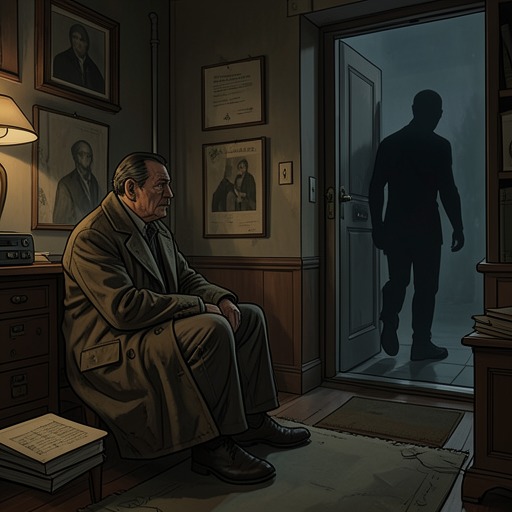
The warning reaches Daniel Upton in a letter delivered by a misshapen, failing messenger who cannot speak intelligibly. The call that precedes the visit comes from the Crowninshield House and consists of bubbling sounds; the paper, however, is in Edward’s handwriting. These details place communication itself at the boundary of bodily identity: Edward’s familiar script survives where ordinary speech cannot, while the source and condition of the messenger remain disturbing and uncertain until the letter explains them.
The aftermath supplies physical evidence without making the mechanism fully observable. The messenger collapses, and the remains found inside Edward’s clothing include a skull identified through dental work as Asenath’s. This supports the letter’s account that Edward’s body had reached Daniel’s door after its occupant had returned to, or become confined in, Asenath’s remains. The story ends without restoring Edward or resolving every uncertainty about Ephraim. Instead, the exchange’s most consequential rule persists as a threat: a body’s death may not end the consciousness that has used it.
Narrative Significance
The concept repeatedly unsettles the distinction between a person and the body by which others recognize that person. Daniel Upton sees a familiar face and must decide whether Edward is present; Edward, in turn, describes being returned to his own body in strange places and seeing another will look out through it. The outward appearance that ordinarily certifies identity becomes unreliable, while handwriting, remembered habits, and the testimony of a close friend offer only partial means of recognition.
The story also delays certainty by making the supernatural account pass through a skeptical listener. Daniel first reads Edward’s claims as delusions, even when he notices changes in Edward’s manner and recalls earlier moments when his friend’s confidences abruptly stopped. Later, the letter and the identified remains support key parts of Edward’s warning, but do not provide a complete account of the exchanges or their cosmic limits. Personality/Soul Exchange therefore functions both as a plot mechanism and as a source of interpretive instability: the reader is given enough evidence to doubt that identity stays with the body, but not enough to make the process safe, predictable, or fully knowable.